ΑΝΑΛΥΣΕΙΣ
Can NATO’s ‘Asia-Pacificization’ sustain its survival?
Global Times Published: Apr 18, 2026
An unprecedented delegation of roughly 30 NATO ambassadors recently visited South Korea and Japan. According to Japanese media reports, it marks one of the largest diplomatic missions to the countries and is seen as a significant step toward an "Asia-Pacific NATO."
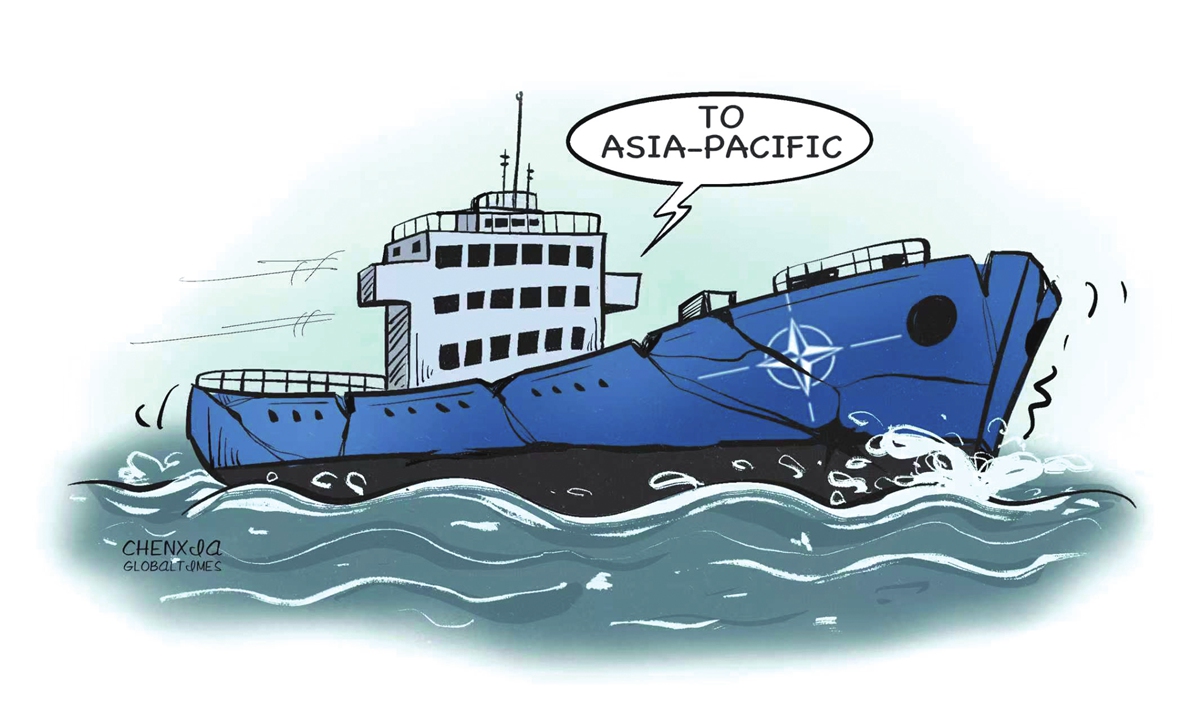
Illustration: Chen Xia/GT
As a regional security alliance of countries from Europe and North America, NATO has in recent years increasingly stretched beyond its treaty-bound geographic scope, extending its reach into the Asia-Pacific region. Behind this move lies not only a continuation of the previous US administration's Indo-Pacific strategy aimed at "containing China," but also reflects the existential crisis and strategic anxieties NATO faces in a changing global landscape. The delegation's visit comes at a time when the very foundation of NATO as a transatlantic alliance is showing widening rifts. As NATO's lead military guarantor and financial backbone, Washington is becoming increasingly unpredictable. From EU's rejection of US request to help secure the Strait of Hormuz, to US' repeated threats to withdraw from NATO, to NATO Secretary General Mark Rutte's "emergency repair" trip to Washington last week, the alliance's internally deep-seated crises are laid bare.Zhao Junjie, a senior research fellow at the Institute of European Studies at the Chinese Academy of Social Sciences, told the Global Times that NATO's European members attempt to enhance the alliance's sense of relevance and promote its value to the US through the visit, while also exploring alternative paths to sustain NATO's security cooperation and defense mechanisms in the event of a weakened and shrinking US role. This dual motivation is reflected in the delegation's agenda. The NATO officials suggested that they want to "learn" from how Japan has managed to maintain stable ties with Washington while adapting to its shifting demands. Meanwhile, the delegation's itinerary, including the tours of Seoul's defense industry sites and Tokyo's US military base, also reveals its intention to use South Korea and Japan as strategic pivots in the region to deepen defense cooperation and meddle in cross-regional security affairs. Yet a fundamental question remains: Can an alliance with a shaking foundation sustain its survival through outward expansion?
NATO's current crisis is not merely a product of US politics, but reflects the alliance's deep-seated structural contradictions that have evolved since the end of the Cold War. Its collective security logic, built on bloc confrontation, is becoming increasingly incompatible with the diverse security interests of its member states in a multipolar world, as well as with broader global trends. Divergences over burden-sharing, strategic priorities, and threat perceptions have gradually widened among member states. The transatlantic rift over Middle East conflict is a clear manifestation of this friction.
In the context, NATO's attempt to shift its internal contradictions outward by advancing "Asia-Pacificization" under the pretext of countering the so-called "China and Russia threats" is essentially a spillover of outdated Cold War thinking and bloc confrontation logic into the region. With its internal value consensus already on the verge of collapse, this approach of diverting its troubles eastward can neither resolve its own existential crisis nor persuade other regions to foot the bill.
Lü Chao, a professor at the Liaoning Academy of Social Sciences, noted that apart from Japan, which attempts to leverage NATO to break through its defense constraints, most Asia-Pacific countries remain highly vigilant and cautious about NATO's 'Asia-Pacificization.'" The Ukraine crisis and Middle East conflict have already demonstrated to Asia-Pacific countries the failure of NATO's exclusionary and confrontational model of collective security, which risks bringing more strife to the region. As a key engine of global economic growth and a high ground for global development, what most countries in the region truly need is stability and cooperation, not bloc confrontation.
As the US continues to signal the possibility of withdrawing from NATO, European members have come to recognize the urgency of change and are accelerating a fallback plan: A so-called "European NATO" under which European countries would assume greater command and control responsibilities. Yet whether it is a "European NATO" or an "Asia-Pacific NATO," such efforts amount to little more than a desperate and self-defeating remedy for an alliance which is a relic of the Cold War.
The author is a reporter with the Global Times.

yiota
Author’s Posts
-
Iraq’s Oil Lifeline Reopens — But Can Baghdad Trust Turkey for Even One Year?
آب 11, 2026
-
Central Asia and Azerbaijan Extend Cooperation Across the Caspian
The Central Asia Times, 11 Augu...
آب 11, 2026
-
Ποιοι Είμαστε
της Παναγιώτας Παπαρούνα
Ο μεγάλος ευρασιατικός μας κόσμος!
Της Παναγιώτας Παπαρούνα
Ιράν: Ο Μοτζτάμπα Χαμενεΐ προχώρησε σε αλλαγές κορυφής – Ετοιμάζεται για παρατεταμένη σύγκρουση