ΑΝΑΛΥΣΕΙΣ
What’s behind growing caution of Australian media toward ‘burgeoning defense links’ with Japan?
Global Times Published: Apr 28, 2026
As Japanese Prime Minister Sanae Takaichi reportedly prepares to visit Australia, the Australian Financial Review (AFR) published an article titled "Japan's hawkish PM could drag Australia into conflict with China."
The piece poses a sharp question to Canberra: "Has Canberra fully thought through the implications of its burgeoning defense links with Tokyo?" The article specifically touches upon a Japanese warship's deliberate transit of the Taiwan Straits on a day laden with significance - the anniversary of the 1895 unequal Treaty of Shimonoseki, under which the Qing Dynasty government was forced to cede Taiwan to Japan - as well as Takaichi's offering of a sacred tree to the notorious Yasukuni Shrine, where Class-A war criminals from WWII are enshrined. The author warns that when Australia keeps schtum publicly on its concerns with regional partners, Tokyo's hawks will be encouraged to believe that Canberra supports their assertive policies.
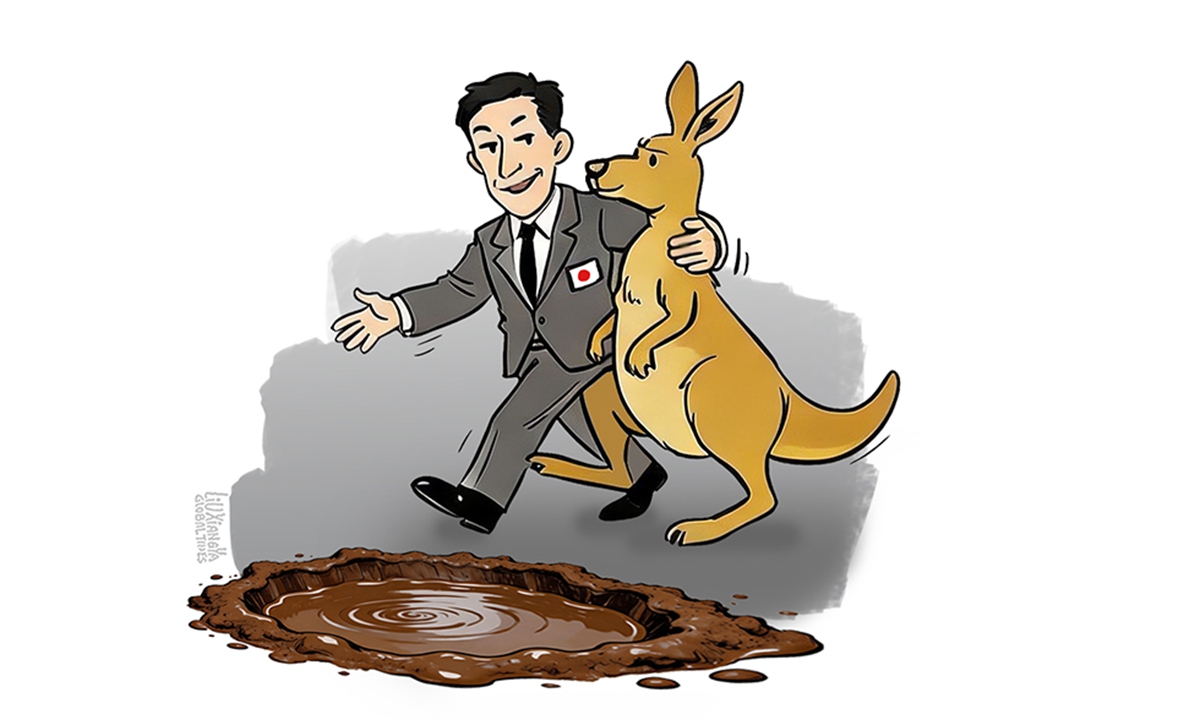
Illustration: Liu Xiangya/GT
While the article's coverage of China still carries the classic Australian filter, its tone toward Japan, Canberra's special strategic partner, and the deepening defense cooperation with Japan, has been noticeably cautious. Readers can sense an unspoken message in the headline that warns against being dragged into conflict. After all, far from the "peace-loving nation" image Japan likes to project, its recent actions are increasingly seen as risky and destabilizing, raising heightened vigilance among many countries. For those who may not be fully familiar with the latest China-Japan tensions, it's important to note that the current standoff was caused entirely by Japan's provocations regarding China's core interests. However, rather than acknowledging its own provocations or showing any willingness to de-escalate the crisis it has created, Tokyo has seized the situation as an opportunity to accelerate its military buildup. It has rapidly increased defense spending, loosened restrictions on lethal weapons exports, joined joint military drills with regional partners, and signed a major warship deal with Australia. The goal is unmistakable: to shed its post-war constraints and fulfill its long-held ambition of becoming a "normal nation" with full military capabilities.Takaichi's deep-rooted hawkish instincts are now on full display. Her relentless actions since taking office are clearly accelerating Japan's remilitarization and neo-militarism. It is somewhat regrettable that, while questioning the rationality of deepening Japan-Australia ties, the AFR article claims that Takaichi might be classified as a "calibrating rather than reckless China hawk." This represents a misjudgment of Japan's increasingly dangerous behavior. The rapid warming of Japan-Australia defense cooperation is Japan's calculated attempt to break free from its post-war military constraints by using allied support to advance its own expansionist ambitions - effectively pulling Australia into a risky entanglement.
Japan is leveraging defense cooperation to gradually draw Australia into its own strategic orbit. Its approach is incremental and deliberate. First, it uses the narrative of so-called "common threat perceptions" to bind Australia rhetorically and politically; then, through a series of defense agreements, it attempts to lock in Australia's strategic resources and commitments. Just recently, Japan and Australia finalized a multi-billion-dollar warship deal, and Takaichi now appears keen to push bilateral military cooperation even further. It is hardly surprising, then, that these rapidly deepening defense links have made some Australian experts increasingly cautious, warning Canberra to think twice before becoming overly entangled with Japan. Much like the rational voices represented by former Australian Prime Minister Paul Keating in the past - who opposed Australia being drawn into confrontation with China on behalf of the US - some are now hoping Australia will reject reckless adventurism and the risk of being dragged into conflict by Japan.
For Australia, deepening ties with militarist Japan carries clear costs and risks. It risks pulling Australia into conflicts over China's core interests, reducing diplomatic flexibility toward Beijing and diverting funds from healthcare, education, and infrastructure to military agendas. Escaping this trap is not overly difficult. It starts with placing Australia's national interests above all else, maintaining strategic autonomy and diplomatic balance while paying closer attention to rational voices at home. Most importantly, it should heed China's clear message: There is no fundamental conflict of interests between China and Australia, and that China's development is an opportunity, not a challenge, for Australia. The growing caution among Australian media and experts toward closer ties with militaristic Japan reflects a broader recognition of the potential consequences of entanglement in regional conflicts. It is imperative for Australia to stay vigilant and thoughtful in its foreign policy decisions.
For Australia, deepening ties with militarist Japan carries clear costs and risks. It risks pulling Australia into conflicts over China's core interests, reducing diplomatic flexibility toward Beijing and diverting funds from healthcare, education, and infrastructure to military agendas. Escaping this trap is not overly difficult. It starts with placing Australia's national interests above all else, maintaining strategic autonomy and diplomatic balance while paying closer attention to rational voices at home. Most importantly, it should heed China's clear message: There is no fundamental conflict of interests between China and Australia, and that China's development is an opportunity, not a challenge, for Australia. The growing caution among Australian media and experts toward closer ties with militaristic Japan reflects a broader recognition of the potential consequences of entanglement in regional conflicts. It is imperative for Australia to stay vigilant and thoughtful in its foreign policy decisions.

yiota
Author’s Posts
-
Iraq’s Oil Lifeline Reopens — But Can Baghdad Trust Turkey for Even One Year?
آب 11, 2026
-
Central Asia and Azerbaijan Extend Cooperation Across the Caspian
The Central Asia Times, 11 Augu...
آب 11, 2026
-
Ποιοι Είμαστε
της Παναγιώτας Παπαρούνα
Ο μεγάλος ευρασιατικός μας κόσμος!
Της Παναγιώτας Παπαρούνα
Ιράν: Ο Μοτζτάμπα Χαμενεΐ προχώρησε σε αλλαγές κορυφής – Ετοιμάζεται για παρατεταμένη σύγκρουση