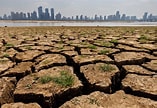
A few in both the littoral countries and the international community are beginning to move from denial to seeking a way to save the sea. Hopes for success, even among activists, are slim, given that the challenges of saving the Caspian are far greater than in the failed efforts to save the Aral, and the consequences of the death of this much larger sea will be far greater (Ulys Media, March 3).
Until relatively recently, people in both the littoral states and the international community tended to dismiss the risk that the Caspian might disappear as a fantasy or at best a very distant prospect. Few could imagine that a sea that has been an important part of the world’s map since classical times could simply disappear. The visible acceleration in the rate of its decline as a result of global warming-induced evaporation from ever shallower waters and increased human use of water in the rivers that feed into the Caspian, however, has begun to change that. The littoral states have been meeting to develop a plan to save the sea (seeEDM, November 16, 2023). An international non-governmental organization (NGO) has been created to address the issue (Window on Eurasia, March 8).
Scholars in countries with a long tradition of denying that there is anything to worry about are now sounding the alarm. Russia, whose leaders have a long tradition of denial about the Caspian’s demise, for example, is now seeing a chorus of voices arguing that Moscow and other capitals must address the sea’s problems or face disaster. An especially important example of this appeared earlier this month in an NG-DipKuryrer article by Sergey Zhiltsov of the Diplomatic Academy and Andrey Kostyanoy of the Institute of Oceanology of the Russian Academy of Sciences (Nezavisimaya Gazeta, March 15).
The two experts point out that the Caspian Sea’s water level has now fallen to its lowest level in the last 400 years. This is inflicting unimaginable ecological, economic, and even political consequences on the littoral states and other countries hoping to use the Caspian basin as a north–south or east–west transit corridor. The decline has hit the northern portions of the sea, the two analysts say, and thus affected the Russian Federation and Kazakhstan especially hard.
The size of the decline is now so large that it is affecting the remaining southern littoral countries of Azerbaijan, Iran, and Turkmenistan as well. These countries have seen access to their ports and shorelines change dramatically for the worse, reducing their ability, and that of their foreign partners, to use the Caspian as they had in the past. Not only are the ports of the littoral states increasingly hard to get to, but even the sea lanes their ships travel are silting up, reducing the amount of cargo they can carry and forcing some countries already to shift to routes passing exclusively overland (Spik.kz, October 7, 2025; Window on Eurasia, July 11, 2025;Nezavisimaya Gazeta, March 15).
The two analysts do not mention another issue that must certainly be on the minds of many in the Russian capital. As the Caspian becomes shallower, others have noted that Russia’s naval advantage there is fading. Its larger ships can no longer pursue the smaller ships that dominate the navies of the other littoral countries, thus shifting the balance away from Russia toward other powers (see EDM, January 21, 2025; Window on Eurasia, June 14, 2025).
The Caspian’s declining water levels are also affecting non-littoral countries that use the Caspian as a source of petroleum or as a transit route. These countries’ usage adds to the number of people involved in developing any solution, making it even more difficult. Theoretically, however, this potentially includes more people and resources that might be directed if there were an agreement. There is an increasing appreciation that, unless agreement can be reached on all the issues facing the littoral states and others regarding the Caspian, then the prospects for any solution are extremely poor. Stavropol’s Center for the Support of Social and Civic Initiatives’ recent study makes this judgement (Akcent, September 10, 2025).
According to its researchers, only a comprehensive program that addresses all these issues has any chance of working as the sea dries up. Otherwise, as the sad history of the Aral Sea’s demise showed, there is a very real danger that the conflicting interests of various stakeholders will prevent the collective action needed to solve the crisis. Coming up with such a comprehensive approach will be extremely difficult given the large number of actors directly and indirectly involved. Consequently, the drying of the Caspian over the next few decades will almost certainly continue and likely trigger new conflicts among these countries, even becoming, in the worst case, a casus belli.
In a region as fraught with dangers as that around the Caspian, one that includes not only Russia but also the PRC, ever more governments will need to get involved in developing strategies to address the Caspian’s problems, however complicated and long-term that challenge may be. The sooner they do so, the easier it will be to address them. The longer they wait, the more likely it is that they will fail, and the death of the Caspian will become truly irreversible—along with the consequences that will inevitably ensue.
- This article was published at The Jamestown Foundation