Thousands of Europeans have been evacuated from the Middle East amid ongoing conflict. How are EU countries coordinating these operations, and what role is Brussels playing. As the war in the Middle East rages on, thousands of flights in the region have been cancelled. Although the total number of European nationals currently in the Middle East is not known, the EU's Emergency Response Coordination Centre (ERCC) has supported around 90 flights bringing citizens back to 14 EU countries, including France, Italy, the Netherlands, and Sweden. The ERCC has two schemes with different expense coverage. The EU can cover up to 75% of repatriation costs for national flights, provided that at least 30% of available seats are offered to citizens of other EU countries. However, if no member state can assist, the European Commission can also organise fully funded flights through the rescEU mechanism.
More than 11,000 European citizens trapped in the Middle East have been repatriated on EU-funded flights, according to a European Commission statement on 16 March. Last week, the fifth evacuation flight with 134 European citizens landed in Bucharest, Romania, following a request from the Romanian authorities. The flight departed from Oman and transported 96 Romanian nationals and 38 citizens from other European countries, who had been stranded in the United Arab Emirates. The EU also covered up to 75% of the road transport costs that passengers incurred to reach Oman. The other four EU-funded repatriation flights happened in the second week of March, the first brought back 356 European citizens from Oman to Romania. The following two flights landed in Warsaw, Poland, bringing back 303 European citizens, of whom 277 were Polish nationals and 76 citizens from other European countries. These citizens had been stranded in Kuwait, Bahrain, Qatar, and the United Arab Emirates. So far, a total of 23 countries have requested EU assistance in repatriating their citizens from the Middle East. "We will continue to protect our citizens wherever they are, stepping in to help when challenges are too great for any one country to face alone," said Hadja Lahbib, Commissioner for Equality, Preparedness and Crisis Management, in a statement.
Repatriation plans on a national level
Across the EU, governments have also carried out repatriations and developed plans for the ones still stranded in the Middle East. In Greece, the Foreign Affairs Ministry announced on 20 March that more than 2,000 Greek citizens returned safely from the war zone.
This operation was carried out by land from Tel Aviv, Jerusalem, and Bethlehem to Egypt, as well as from Kuwait, Bahrain, and Qatar to Saudi Arabia. Additional flights were arranged to bring citizens back Oman, the Emirates, Qatar, and Saudi Arabia.
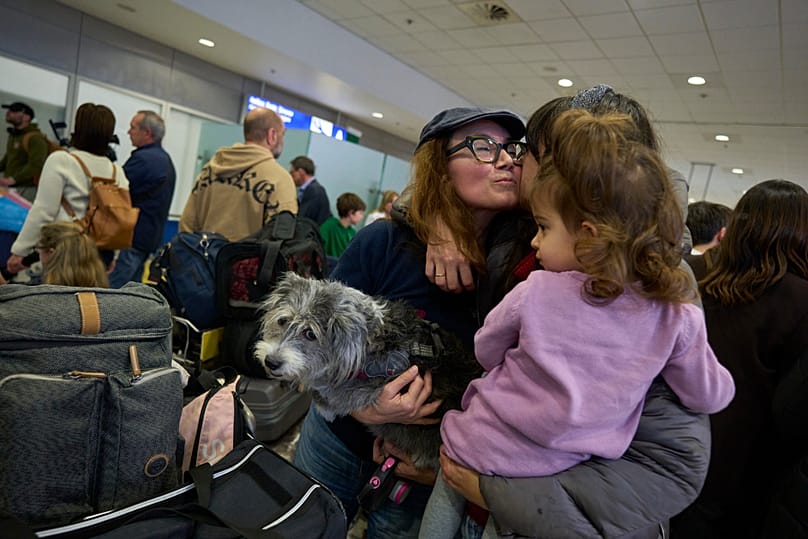
A repatriated Greek woman with her dog hugs relatives during their arrival at Athens International Airport Eleftherios Venizelos after being evacuated from Abu Dhabi.AP Photo
In Italy, around 25,000 Italian nationals, who were in the region for tourism or as immigrants, have returned to their homeland. However, the Ministry of Foreign Affairs estimates that there are around 90,000 Italians in the Middle East and the Gulf region, according to the department's latest note. In France, nearly 20,000 French nationals have been repatriated from the Middle East, according to the government spokeswoman, Maud Bregeon, on 11 March. It is estimated that around 400,000 French people live or were travelling in the region when the war erupted. Spain has also carried out the evacuation of 8,000 Spaniards since the beginning of the war, according to a press release on 13 March.