
DW By Dang Yuan, 16 March, 2026
Minority groups fear repression
The law, which contains 65 articles, will enter into force on July 1.

Article 1 states the purpose of the ethnic unity law is to "forge a strong sense of the community of the Chinese people, advance the establishment of the community of the Chinese people, and promote the realization of the great rejuvenation of the Chinese people." The law does not specify concrete penalties for violation, instead referring to the criminal code. "Where the organization, planning, or carrying out of violent terrorist activities, ethnic division activities, or religious extremist activities constitutes a crime, criminal responsibility is to be pursued in accordance with law," according to Article 62.
Critics see the law as allowing authorities in Beijing more room to frame ethnic groups' demands for cultural autonomy as a push towards "separatism." "In combination with the 2016 anti‑terrorism law, which served as the legal basis for the mass internment camps, this new law will further intensify the repression of Uyghurs in East Turkestan, particularly with regard to linguistic, cultural and religious freedoms," Turgunjan Alawdun, president of the Munich‑based World Uyghur Congress, told DW. The congress serves as a political advocacy organization for exiled Uyghurs. Alawdun refers to China's northwestern Xinjiang province as "East Turkestan," a term that's popular among Uyghur separatists. Mass camps for Uyghurs, a Turkic-speaking predominantly Muslim minority, have been built in Xinjiang under the guise of "vocational education and training centers" used to combat "extremism and terrorism." "Over the past ten years, measures of forced assimilation and the Sinicization of Uyghur cultural and religious identity have already caused severe harm," Alawdun added.
The law has accelerated Beijing's efforts to suppress ethnic minorities, particularly in Tibet and Xinjiang, said Jack Burnham, a senior research analyst at the Washington‑based Foundation for Defense of Democracies. The law provides a de facto legal justification for this repression. "Specific measures by the state include banning Uyghurs from participating in prayers and destroying historic mosques," Burnham told DW. Incentives have also been created to encourage Han Chinese to resettle in large numbers in Uyghur areas. At present, Uyghurs make up only about 45% of the population in their own autonomous region of Xinjiang.
Change in language hierarchy
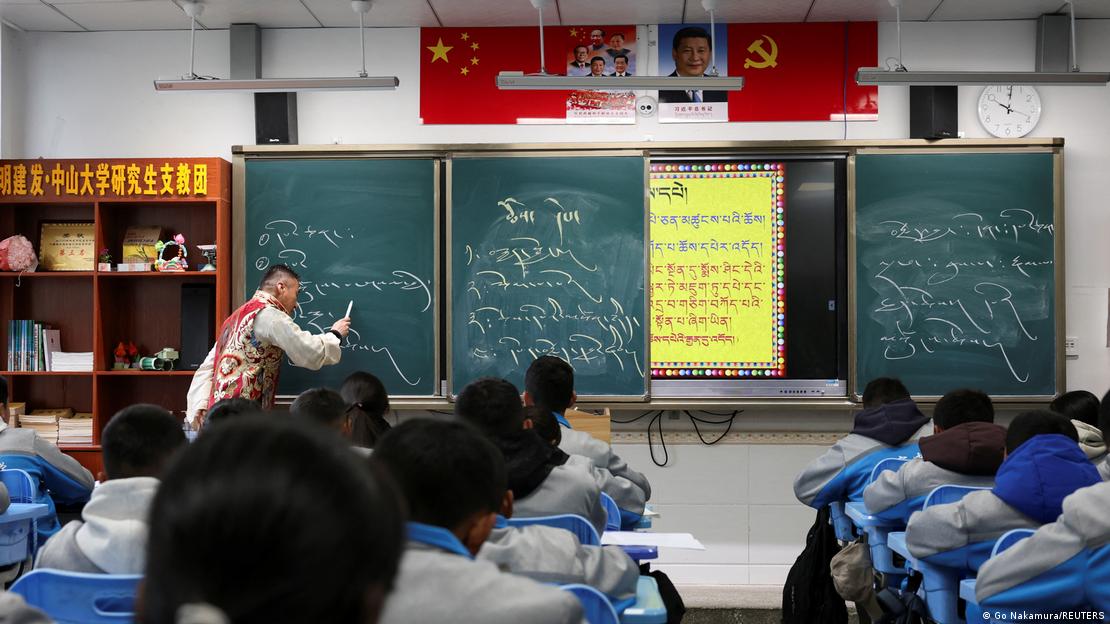
Several large ethnic groups in China still have their own languages and scripts. These are depicted, for example, on Chinese banknotes. However, the new law places the official language of the Han Chinese above other dialects. "Schools and other educational institutions are to use the nation's common language and script as the basic language and script for education and teaching," the law states. "The state is to promote preschool students' learning of Mandarin, so that youth who have completed compulsory education have a basic understanding of the nation's common language and script." Ideologically and politically, all ethnic groups are to be more closely bound to the Han‑dominated majority society and to the Communist Party. The law requires the state to "lead each ethnic group to carry forward an ethnic spirit with patriotism at its core… and persist in identifying with the great motherland, the Chinese people, Chinese culture, the Chinese Communist Party, and Socialism with Chinese Characteristics." This, Burnham argues, promotes "Han nationalism." "In addition to the emphasis on Mandarin rather than regional languages in education and public services, the law forces minorities to live in 'mixed communities' with a substantial Han population," he said. In regions inhabited by ethnic minorities, resistance has so far been strong when it comes to their languages and scripts, which are seen as the last remaining markers of their identity. In 2020, large‑scale protests erupted in the Inner Mongolia autonomous region after local education authorities banned the use of Mongolian‑language textbooks in primary and middle schools.
