The Times of Central Asia, 13 October 2026, Aidar Borangaziyev
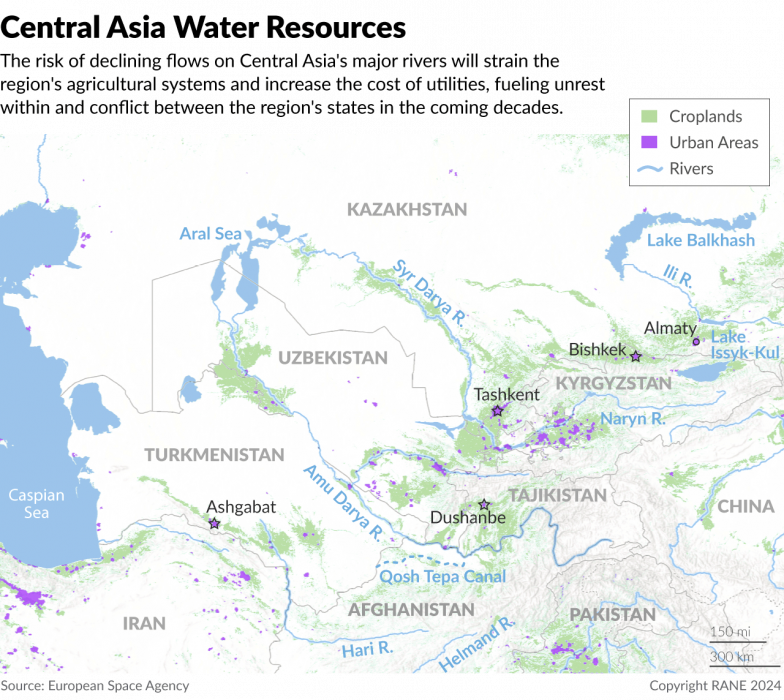
In modern diplomacy, Central Asia usually means five post-Soviet states: Kazakhstan, Kyrgyzstan, Tajikistan, Turkmenistan, and Uzbekistan. But how fixed are the region’s boundaries, and who gets to define them?
Should Central Asia be understood as the five states that have emerged as a distinct political space? A broader historical and cultural region that includes Afghanistan, parts of Iran, western China, and Mongolia? Or an even more fluid system of economic, transportation, and strategic ties?
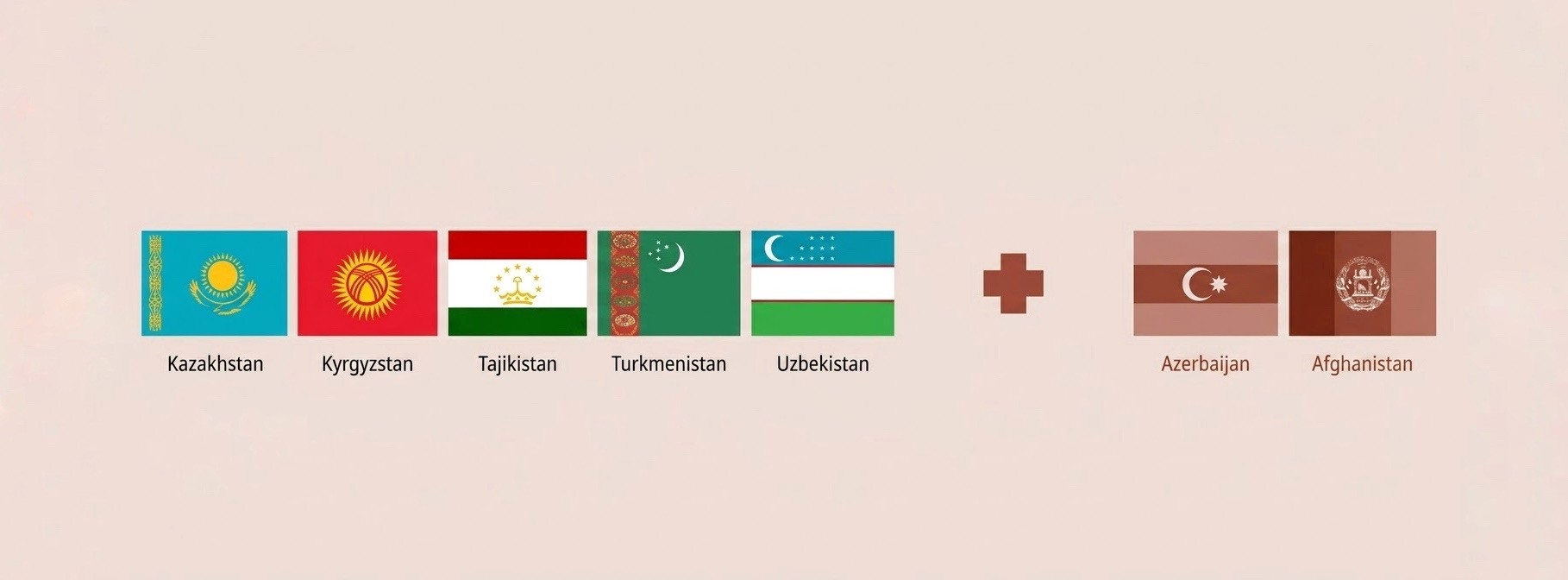
New details about the origins of the C5+1 format involving the United States bring us back to precisely this question. Frederick Starr, one of the most consistent proponents of the Greater Central Asia concept, recently wrote that including Afghanistan was considered during early discussions of the American regional mechanism. In that case, the formula could have been C6+1.
What makes this episode interesting is not that Afghanistan supposedly almost became the “sixth country of Central Asia.” More importantly, even before C5+1 was launched in 2015, there were different ways of understanding the region: political, historical and civilizational, and strategic. Those differences persist today, while closer relations with Afghanistan and Azerbaijan have once again raised questions about Central Asia’s boundaries.
Political Central Asia and the C5
Politically, the definition is relatively clear. After the collapse of the Soviet Union, Kazakhstan, Kyrgyzstan, Tajikistan, Turkmenistan, and Uzbekistan gradually developed from a geographical grouping into a distinct political category.
C5+1 reflects precisely this logic. The joint declaration adopted in Samarkand on November 1, 2015, established regular cooperation between the United States and the five Central Asian states. Afghanistan was part of the regional agenda but was not included in the format itself.
The “five plus an external partner” model has since proliferated. Germany uses the Z5+1 formula, from the German Zentralasien. Similar regional mechanisms operate with Japan, South Korea, the European Union, China, India, Russia, Italy, the Gulf Cooperation Council, and other partners.
The proliferation of these formats reflects the extent to which external partners increasingly treat the C5 as a regional actor in its own right, while the five countries themselves are also increasingly acting in that capacity.
But political Central Asia is not the only way to view the region.
As part of UNESCO’s multivolume History of Civilizations of Central Asia project, the region was understood much more broadly. This historical and cultural space included not only the five former Soviet republics but also Afghanistan, northeastern Iran, Pakistan, northern India, western China, and Mongolia. UNESCO specifically noted that these were not rigid political boundaries but an area shaped by long-standing cultural and historical ties.
This does not offer a “correct” alternative map. Rather, it shows that the region’s political, historical, and civilizational boundaries do not necessarily coincide.
It was against this background that Starr proposed the concept of Greater Central Asia in 2005. This represented a third, strategic way of viewing the region. His idea was less about redrawing the geographical map than about changing American policy. In Starr’s view, the five post-Soviet republics and Afghanistan should be considered within a broader economic and infrastructure framework. Security, trade, energy, transportation, and access to South Asia were too closely connected to be separated into different areas of policy.
Almost a decade later, this logic found practical expression. A joint Kazakh-American expert report published in 2014, Looking Forward: Kazakhstan and the United States, explicitly proposed creating a “Central Asia Six Plus One,” a permanent mechanism involving the United States, the Central Asian countries, and Afghanistan.
This was an expert proposal rather than an agreed intergovernmental format. There is no evidence in the report that the C5 governments had agreed to treat Afghanistan as part of a common political framework. According to Starr’s recent account, however, the idea of a broader format subsequently reached the diplomatic level and was discussed by senior U.S. officials.
This is not a dispute over which definition is “more correct.” Each answers a different question. C5 describes the political identity of the five states; the historical and civilizational approach describes an area of long-standing ties; Greater Central Asia offers a strategic framework for policy and infrastructure. Problems arise when one level is presented as another.
Afghanistan and the Limits of the C5
Today, the question is becoming relevant again, but without a Western military presence in Afghanistan and in a very different political environment.
In April 2026, the first “Afghanistan-Central Asia Consultative Dialogue” took place in Kabul, with representatives of all five Central Asian states participating. The name of the format itself is telling: Afghanistan and Central Asia appear as two sides of the dialogue.
Kabul, however, promotes a broader interpretation. Afghan authorities speak of “regional convergence” and seek to present Afghanistan not as an isolated territory but as a connecting space between Central and South Asia.
This is primarily Afghanistan’s vision of a desirable regional architecture. The C5 countries are more cautious. They are interested in a stable Afghanistan, are expanding trade, and support transportation and energy projects. For now, however, this is more about involving a neighboring country in regional processes than about revising Central Asia’s political framework.
Even within the C5, there are differences in emphasis.
Uzbekistan offers the broadest formulation. In 2025, Shavkat Mirziyoyev stated that Afghanistan is “not a periphery, but a natural part of our shared region.” For Tashkent, its inclusion is closely tied to transportation and economic connectivity between Central and South Asia.
Kazakhstan uses more cautious language but also consistently opposes the isolation of Afghanistan. Kassym-Jomart Tokayev’s statements emphasize the country’s reconstruction, its involvement in regional and international processes, and the development of trade, infrastructure, and transportation links.
This approach is consistent with Kazakhstan’s broader foreign policy principle of rejecting the logic of a “zero-sum game.” Tokayev has proposed replacing the traditional “Great Game” with a model of mutual benefit that he calls “Great Gain.” Applied to Afghanistan, that approach points toward integration primarily through economics, infrastructure, and multilateral mechanisms rather than through formally redefining the region’s boundaries.
Tashkent and Astana therefore agree that Afghanistan should not remain isolated. But Uzbekistan is prepared to use an almost geographical formulation of shared regional belonging, while Kazakhstan places greater emphasis on practical engagement.
Azerbaijan and a Different Kind of Expansion
Against this background, proposals to expand C5+1 into C6+1 by adding Azerbaijan are particularly interesting.
The U.S. format has not yet made that change and continues to operate officially as C5+1. But the political basis for including Azerbaijan is very different from the earlier Six Plus One proposal involving Afghanistan.
In November 2025, the heads of the Central Asian states decided to grant Azerbaijan full participation in the Consultative Meetings of the Heads of State of Central Asia. This was not an external expert model but a decision by the region’s own countries.
There is also a practical logic behind it. The Caspian Sea, the Middle Corridor, energy links, and growing transportation connectivity are bringing Central Asia and the South Caucasus ever closer together.
Afghanistan and Azerbaijan therefore cannot be viewed in the same way in the context of a possible “sixth place.” They represent two different paths of external connectivity for the C5. The Afghan direction is developing primarily through trade, security, infrastructure, and separate dialogue mechanisms. Azerbaijan, by contrast, has already been incorporated into one of Central Asia’s main political consultation mechanisms by a decision of the Central Asian states themselves.
This is perhaps where the main conclusion lies. External powers, international organizations, and schools of thought can propose their own versions of Central Asia, narrower or broader, based on history, culture, security, or transportation connectivity. This is how both the Greater Central Asia concept and the Six Plus One idea emerged.
However, the political character of the region is increasingly being shaped by the Central Asian states themselves: through their own mechanisms of cooperation, their choice of partners, and their decisions about whom they are prepared to include and in what form.
The question of Central Asia, therefore, has never been solely about how many countries to place before the “+1” sign. Far more important is what different participants understand by the region itself and what kind of Central Asia they want to see.
Perhaps the main change of recent decades is that the answer to this question is increasingly being determined by the region itself rather than from outside.